How long does it actually take a child to learn to read when they aren’t learning to read at school?
Reading can be one of the hardest areas for a homeschooling parent to step back and trust.
Even when we’ve chosen to leave school expectations behind, we still carry ideas about when children should read, what learning to read is supposed to look like, and how quickly the process should happen. When our child’s experience doesn’t match those expectations, worry can take over.
So earlier this year, we asked the families in the 90-Minute School Day in the Life community a simple question:
How did your child actually learn to read?
We wanted to look beyond the point when a child could finally read independently and learn more about the process that came before it.
What does learning to read actually look like outside of school?
In this episode of the 90-Minute School Day Podcast, DITL member Elizabeth Schroder joins us to share and discuss the results of our community survey on how children learn to read outside of school.
Elizabeth brings a particularly interesting perspective to the conversation. She has a background in elementary and early childhood education, has worked with children both individually and in classrooms, and watched her own daughter learn to read English entirely outside of school while learning Japanese literacy through traditional schooling.
Together, we talk through the three stages of learning to read and what our survey revealed about the real-world reading journeys of children in our community.
We look at:
- How we define the different stages of learning to read
- Why there isn’t one predictable path from emerging reader to independent reader
- How long children in our survey spent in the emerging-reader stage
- The wide range of ages and timelines for becoming an independent reader
- The different ways parents supported reading development
- How often children practiced reading and for how long
- Whether reading support was invited by children or required by parents
- Who was leading the process toward independent reading
- What parents noticed when they looked back at their child’s reading journey
How long does it take to learn to read?
One of the most important things we discovered is how much of the reading journey disappears when we only measure the finished product.
A child eventually becomes an independent reader, and we tend to look backward from that point and assume the process was relatively straightforward.
But learning to read can include a long period of noticing print, listening to stories, developing language, playing with sounds, recognizing words, experimenting with writing, being read to, reading familiar texts, asking questions, practicing skills, losing interest, returning to them, and gradually putting more pieces together.
For some children, this process happens relatively quickly. For others, it unfolds over years.
And when children are learning outside of school, there may be much less visible “reading practice” than we expect because reading is embedded in the rest of their lives.
That’s one of the reasons we wanted to conduct this survey: to get a closer look at what learning to read actually looked like in real families rather than only looking at school-based expectations.
Reading happens on a spectrum
This conversation isn’t intended to offer another timeline for parents to compare their children against.
Our survey was a small snapshot of families in the DITL community. It isn’t a research study, and it doesn’t tell us how every child learns to read.
What it does give us is an opportunity to notice the range.
Children can arrive at independent reading through different pathways, with different amounts of support, at different ages, and over very different periods of time.
That matters when we’re trying to understand a child who isn’t following the reading timeline we’ve been taught to expect.
And it matters even more when a child is dealing with school-related fear, burnout, neurodivergence, learning differences, or a period when their capacity for formal instruction is very low.
Sometimes the question isn’t simply, “How do I get my child reading?”
It may be, “What is happening in this child’s reading development right now, and what does this child need from me?”
If reading is causing you worry
If you’re in the middle of the emerging-reader years and finding yourself constantly wondering whether your child should be farther along, you’re not alone.
There can be a lot of emotion attached to reading. Parents may worry about falling behind, future opportunities, dyslexia, whether they’ve provided enough instruction, or whether giving a child more time means they’re neglecting something important.
Those worries deserve compassion and honest attention.
At the same time, fear doesn’t necessarily give us the clearest picture of what our child is learning.
Stepping back and looking at the whole reading journey can help us notice the pieces that are easy to miss when we’re focused on whether a child can or cannot read independently yet.
That’s what we explore in this conversation.
More from the Rethinking School and Learning podcast series
This is the second episode in our four-part Rethinking School and Learning series.
In the first episode, Heidi Steel shares about her book School Isn’t for Everyone and the assumptions we carry about school, learning, and what children need.
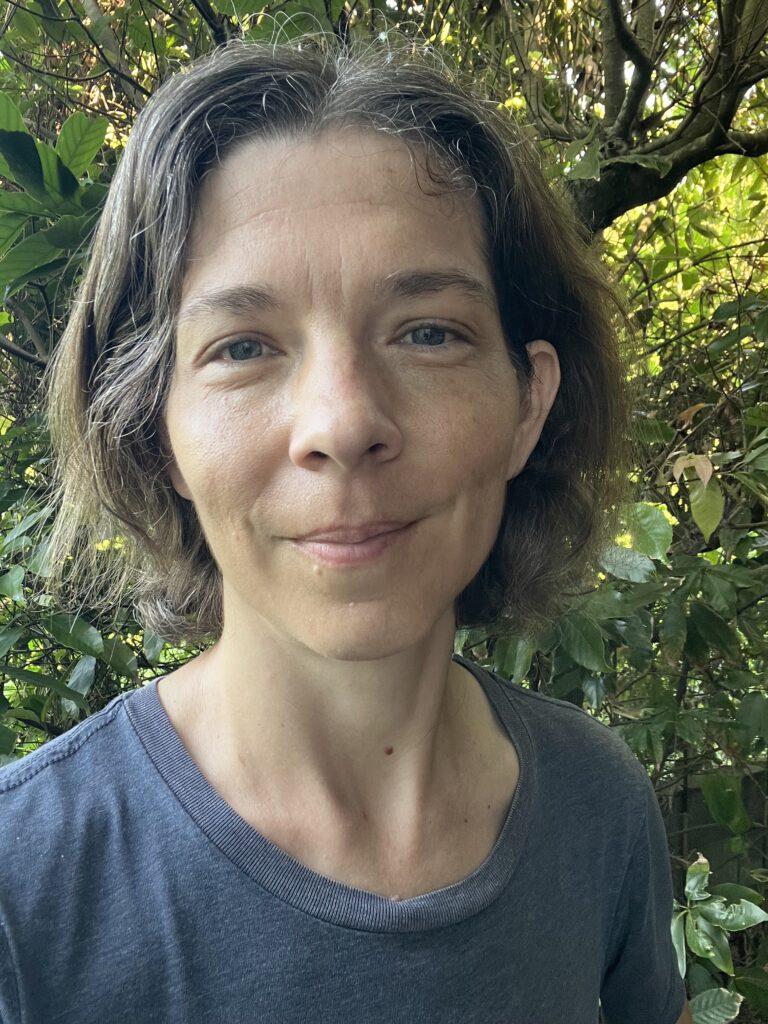
elizabeth schroder
Elizabeth is a reader, writer, poet and lifelong learner living on a tiny island in the Seto Inland Sea in Japan, where she raises her daughter alongside her wife and many chickens. She grew up in the American Midwest, moved to California in her mid-twenties, and eventually found her way to one of the quieter corners of the world.
Elizabeth brings a uniquely layered perspective to the question of how children learn to read. She has a background in both elementary education and early childhood education, and has spent time working with students 1:1 and in the classroom. After becoming a mother and moving to Japan, her daughter learned to read English entirely outside of school, while acquiring Japanese literacy through traditional schooling, giving their family a rare side-by-side view of both paths. Elizabeth herself has learned to read and speak Japanese as an adult, with little formal instruction, and knows firsthand what it feels like to become a reader on your own terms.
A lover of nature, story, and the written word, she can often be found with a cup of tea and a good book — and has spent considerable time thinking about what it really means to become a reader.
Resources and Support
- DITL is an online community for parents supporting one another as they raise neurodivergent children outside of school. Doors open three times a year, in late October, late March, and late July. Join the invite list at 90minuteschoolday.com/day-in-the-life/
- 90-Minute School Day private coaching is currently available if you need support now.
- Listen to or invite Kelly to speak about the 90-Minute School Day™ here.
Other Episodes/Resources on Reading
- 57 – I’m Not Reading, But Everyone Else IS with Carrie De Francisco
- 53 – What If School Creates DYSlexia? with Je’anna Clements
- 52 – Becoming Brave Writers with Julie Bogart
- 36 – Reimagine Reading: It’s Not A Race
- See Jo Isaac’s 2018 Survey on Reading Age In Unschooled Kids
- Jo’s 2016 survey published on Sandra Dodd’s website
- Heidi’s book, School Isn’t For Everyone
At the end of the day, trust your instincts and explore alternatives to what isn’t working!
I’d love to connect personally, find me on Instagram.
You’re doing a great job, let’s make it easier!
Kelly
Be Featured on the Podcast!
The 90-Minute School Day™ podcast aims to support all homeschooling families with a focus on neurodiverse families, with learning differences and unique learning styles. Be featured on the podcast by sharing your story, struggle or asking your question here. Or leave your recording by clicking the mic below.